Should the Internet be Taxed?

Should the Internet be Taxed?
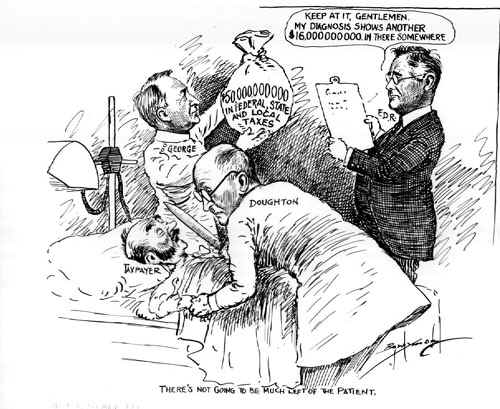
There's
Not Going to be Much Left of the Patient
Artist: Clifford Kennedy Berryman
Date: June 10, 1943
Short-sighted "brick and mortar" merchants, like
kindergarten students, cry out, "It ain't fair!" You tax me, why
don't you tax them? But what is stopping those "brick and
mortar" merchants from joining the internet gold rush themselves? If
it's so unfair, then why don't they simply hop on board?
Government will find a way to tax just about anything. If
you doubt this, you might want to take a look at For Good and Evil: The
Impact of Taxes on the Course of Civilization, Second Edition, by Charles
Adams (Madison Books, 1999), a superb treatise on the history of taxation.
Here are some suggested links to both sides of this
question. (We suspect you know where we stand!)
The Advisory Commission on
E-commerce: According to this site (now closed and no longer
updated), "The Advisory Commission on Electronic Commerce was created by
Congress and tasked with producing what is arguably the most important policy
initiative of the information age: recommendations on electronic commerce and
tax policy, critical issues with global implications. The Commission completed
its work with its Report
to Congress, which was delivered on April 12, 2000."
Should
We Tax the Internet? The
Institute
for Policy Innovation says, "The states don't need the additional
revenue and there is no fair tax. That being the case, there is no justification
for taxing Internet access or sales."
Electronic Commerce and Tax Policy.
Includes a number of pro-tax links. Brought to you by The
Tax Association (notice there's nothing here to suggest these fellows have
anything to do with taxpayers - just taxes), who pride themselves for "not
promot[ing] any particular tax program or policy."
Streamlined Sales
Tax Project. The Streamlined Sales Tax Project is "a cooperative
effort of states and localities to respond to repeated calls for simplification
of the sales tax and concerns about the impact of applying the current system to
the burgeoning electronic commerce world." (Hey, fellows - think
about this. No tax is about as simple as it gets, wouldn't you
say?) How
Taxation Threatens to Shut Down Commerce On The Internet. This
comprehensive article is published by Citizens
Against Government Waste ("CAGW"). CAGW is "a 600,000
member, private, non-partisan, non-profit organization dedicated to educating
Americans about the waste, mismanagement, and inefficiency in the federal
government. Founded in 1984 by the late industrialist J. Peter Grace and
syndicated columnist Jack Anderson, CAGW is the legacy of the President’s
Private Sector Survey on Cost Control, also known as the Grace Commission."